Dariusz Wolski ASC: The cinematography of Nuremberg
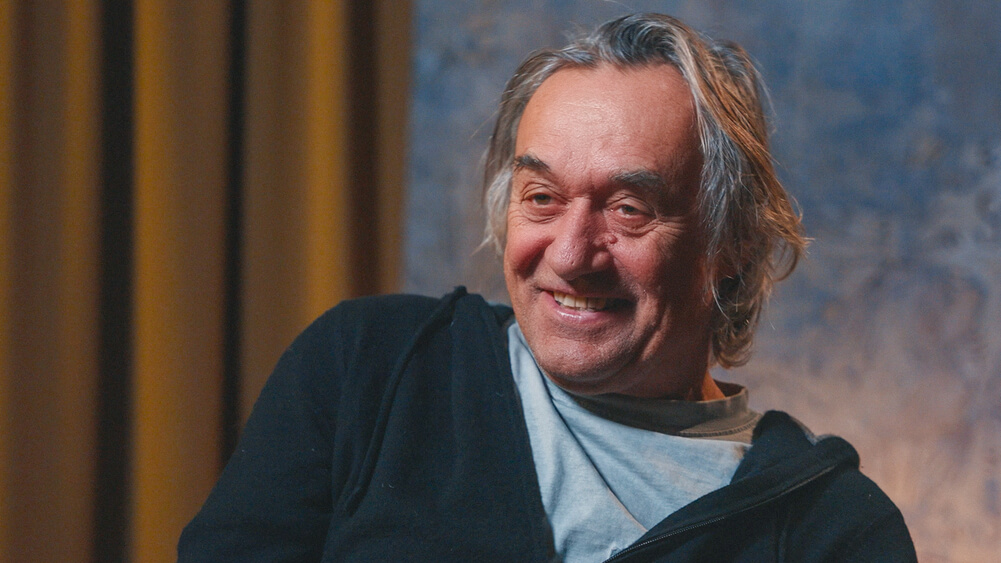
In director James Vanderbilt’s feature Nuremberg, Rami Malek plays Douglas Kelley, an American psychiatrist tasked with evaluating Nazi leaders — including Hermann Göring (played by Russell Crowe) — ahead of the Nuremberg trials of 1945-’46. As cinematographer Dariusz Wolski ASC recounts in this exclusive video interview, he and his collaborators strove to craft a visual language that prioritized historical accuracy, restraint and performance. In so doing, Wolski would draw on influences including film footage of the actual Nuremberg trials, street photography, and wisdom gleaned from his long-running collaboration with director Ridley Scott.
Interesting Spaces
As Wolski explains, the movie takes place in two distinct environments. “One story is a trial,” he says, and “another story is whatever was happening in the prison cell between Rami and Russell.”
The filmmakers strove to treat the prison-cell set as though it were a practical location. “We broke the wall once,” Wolski recalls. “That was my challenge. You take the wall out, you can have a pretty picture. Impossibility makes it more interesting, I think. You just create a space for them to [act] and make the space look as interesting as it can be.”
In this approach, the cinematographer found inspiration in still photos. “I always go back to great, great street photography,” he shares. “The guy comes in and takes a still, and it’s like, ‘How come it's so great?’ Because he just captured the context and the great space with the great light, great composition, and a great story because it's usually somewhere in an exotic place or a place that normally you're not comfortable to be in.”
Single-Source Lighting
Preproduction found Wolski working closely with Vanderbilt and production designer Eve Stewart. “The production designer always does bigger research than everybody else,” Wolski notes, “so when you come in, you have already a lot of stuff to start with.
“In the prison, there's only one light,” he continues. “The beginning is always starting from reality. Eve showed up with this real photograph of a bare bulb and a cage over it. And I said, ‘Well, let's just photograph that. See what that looks like.’ And so we used bare bulbs, so we have a very hard shadow. And then I asked her to make the cage a little bit thicker so I had shadows on the walls. That was my starting point, and I tried to use it as much as I could. Sometimes you have to use a little fill here and there because you want to see their eyes, but [otherwise] it's bare bulb front light, and when it's backlight, it's backlight. And that's what gives you the reality of the thing.
“If you put the light in the right place, you can shoot the whole scene that way,” the cinematographer adds. “I was listening to Vittorio Storaro [ASC AIC], who said once his ideal thing is to shoot the movie with one light. I still believe in that. I still try to do it.”
Historical Reference
The actual Nuremberg trials were famously documented on film, providing a key historical reference for the Nuremberg team. “The interesting part in doing the trial, because it was filmed, there are a couple shots [recreated] from shooting booths,” Wolski explains. “There were cameras in these special rooms because they had to be protected — they were too loud [and would otherwise] interfere with the trial, so they were in two boxes. One, actually, you can see was right behind Jackson [played by Michael Shannon], and another one was to the left.
“Film was like 80 ASA at the time, so they needed a lot of lights,” the cinematographer adds. “So that's why those big lights are on top of the judges. They were just bare bulbs. I just took it from reality. And then our audience was a little bit more in shadow. It was lit by whatever ambience comes from the bright spots.”
Working With Multiple Cameras
With the trial scenes, Wolski found himself drawing on his experiences collaborating with director Ridley Scott, who favors working with multiple cameras to capture reverses in the same take. “There was such a huge amount of dialogue for them to go through [in the courtroom],” Wolski reflects. “I just kind of went back on my experience with Ridley. So we put four cameras to be able to do it.”
Within the set, the cinematographer adds, the actors “were far away from each other, so you could get rid of the middle and put two cameras [facing opposite directions], and both those cameras can be pushing in and pushing out. And then you put two profile [cameras] going in and out. So you can choreograph the whole thing, and they can just go for it. When actors perform, this way they can overlap dialogue. It's just so important. I believe in that. That's Ridley’s school, and I believe in that.”
Great Advice
Whatever the project, Wolski’s goal is to craft compelling visuals that draw viewers into the story. “I don't believe in pretty photography,” he says. “If somebody tells you your movie looks great, what does that mean? What, pretty pictures? I've done enough high-fashion commercials and stuff too. Photography should be interesting, not pretty. I'm going to quote Ridley again because anytime you do something, he’s always going, ‘Just don't make it too cosmetic. Don't make it too cosmetic.’ It’s just such great advice.”
Related Products and Services
This is a carousel with manually-rotating slides. Use Next and Previous buttons to navigate.